DERs Are Entering the Market. What It Means for You.
ISO Market Edge by Hartigen | Volume 9
Key Takeaways:
A new class of resources can now participate directly. FERC Order No. 2222 allows Distributed Energy Resources (DERs) to provide wholesale market services through aggregations (DERAs), opening ISO-NE markets to a broader set of participants.
Two timelines to track. Energy and Ancillary Services participation begins November 1, 2026, while Capacity Market participation follows in Commitment Period (CP) 2028/2029.
System and process changes are already underway. eMarket, MIS, and meter reading submission processes are all being updated to support DER and DERA participation, with corresponding PowerOptix updates in Release 2026.10.1.
About the Market Change
FERC Order No. 2222 removes long-standing barriers to Distributed Energy Resource (DER) participation in wholesale electricity markets. Under this order, DERs (such as rooftop solar, battery storage, electric vehicles, and demand response) can now participate in ISO-NE markets through an aggregation of resources, referred to as a DER Aggregation (DERA).
This is a structural expansion of who can participate in wholesale markets and how. Rather than requiring each individual resource to meet wholesale market participation thresholds on its own, DERs can now be pooled together into a DERA that meets those requirements collectively. For market participants, this means new resource types, new participation pathways, and new system functionality to support them.
Two distinct timelines apply:
Energy and Ancillary Services Markets: DER/DERA participation begins November 1, 2026.
Capacity Market: DER/DERA participation begins with Commitment Period (CP) 2028/2029.
Why it Matters
For business leaders, this order represents a meaningful shift in market structure and competitive landscape. New participants, new resource categories, and new aggregation models can influence everything from market liquidity to settlement complexity to strategic positioning for organizations that manage or aggregate distributed resources.
For technical teams executing the change, the impact is more immediate and operational. Several core systems require updates to support DER and DERA participation:
eMarket: New Portfolio Manager displays, DER generation and load offer submission, and cleared results retrieval. Access to the new DER tab will require new user roles.
Market Information Server (MIS): Reports will be updated to accommodate resources settled at DERA zones.
Submit Meter Reading: The UI will be updated to reflect location changes associated with DERs.
Together, these changes mean that both the business case for participating in this new model and the technical readiness to support it need to be addressed ahead of the November 2026 start date.
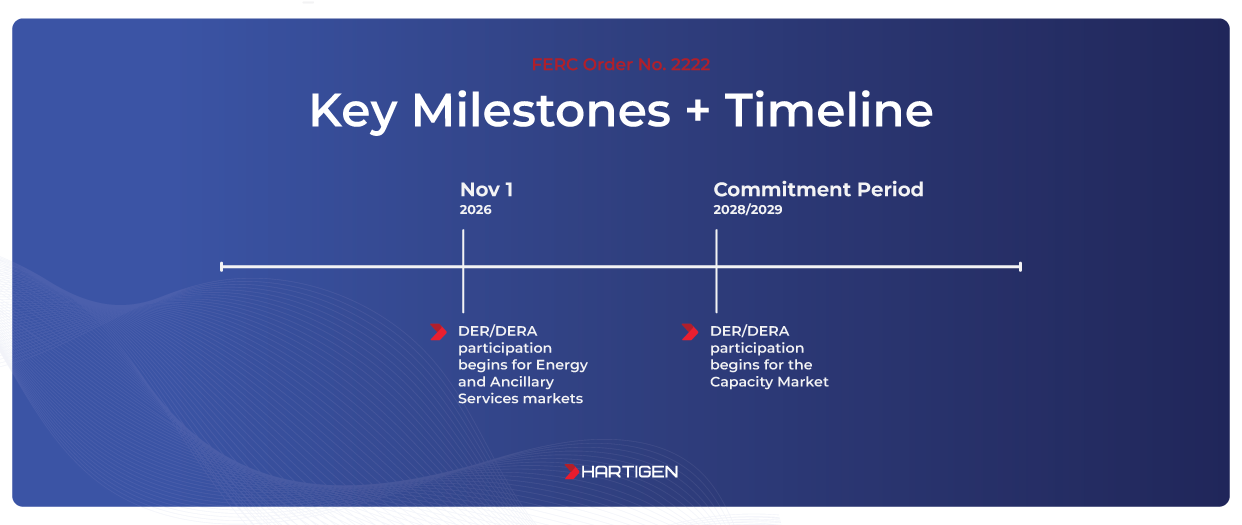
The Energy and Ancillary Services date is the one to prioritize first, as it directly precedes the PowerOptix release and sets the operational clock for near-term readiness. The Capacity Market timeline gives additional lead time but is worth factoring into longer-range planning now rather than later.
What’s Driving the Change
FERC Order No. 2222 reflects a broader national push to modernize wholesale electricity markets and better integrate smaller, distributed resources alongside traditional generation. By allowing DERs to participate through aggregation, the order aims to increase competition, improve grid flexibility, and give a wider range of resource owners a pathway into wholesale markets that was previously impractical for smaller, individual assets.
ISO-NE, like other regional grid operators, is responsible for implementing the order within its own market rules and systems, which is what's driving the specific eMarket, MIS, and PowerOptix updates outlined here.
How to Prepare
Here's where we'd suggest focusing first:
Assess your DER/DERA participation strategy. If your organization manages or could aggregate distributed resources, determine whether and how you intend to participate under the new DERA model.
Review user access and roles. The new eMarket DER tab will require new roles. Identify who on your team will need access and plan for provisioning ahead of go-live.
PowerOptix Release 2026.10.1. This release delivers the new location types, offer submission windows, meter data updates, and market results views needed to support DER/DERA activity.
Validate meter and location data. With updates to Submit Meter Reading and new location types being introduced, it's worth reviewing your meter data setup now to confirm it will align with the new structure.
Align business and technical teams early. Since this change touches both strategy (participation decisions) and execution (system readiness), we'd recommend looping in both groups now rather than treating this as a purely technical update.
As always, if it would help to walk through how this applies to your specific setup, we're glad to work through it with you rather than leave you to interpret the order alone.
Additional Considerations
Capacity Market lead time: While CP 2028/2029 feels distant, aggregation strategies, resource contracts, and internal approval processes for Capacity Market participation often take longer to stand up than Energy and Ancillary Services participation. Worth starting that conversation now.
Role and access planning: New user roles for the eMarket DER tab mean access requests should be identified and submitted with enough lead time to avoid last-minute bottlenecks around November 1.
Settlement and reporting changes: DERA zone settlement is a new concept for many participants. We'd recommend confirming your internal reporting and reconciliation
Vendor and third-party coordination: If you rely on third-party aggregation platforms or metering vendors, confirm they are also tracking this order and updating their own systems in parallel with ISO-NE and PowerOptix changes.
Resources
For more information on FERC Order No. 2222, please refer to:
Hartigen’s Role
Market changes like this one are constant across ISO/RTO markets and staying ahead of them without disrupting your operations is exactly what PowerOptix is built to do. Rather than leaving customers to track, interpret, and implement every version update on their own, Hartigen continuously monitors evolving market rules and builds the corresponding updates directly into the platform.
For the FERC Order No. 2222 transition, the necessary changes were incorporated in our October 16, 2026 PowerOptix release 2026.10.1, so customers can stay current without taking on the technical burden themselves. It’s a core part of what sets PowerOptix apart, a platform designed to keep pace with the market, so your team doesn’t have to. Learn more, here.
Stay Ahead of Market Change
If you have questions about how this transition may affect your integrations, or want help planning your testing timeline, reach out to your Hartigen representative. Not working with a Hartigen representative yet? No problem. Let us connect you with someone on our team.
References
Content in Volume 9 of the ISO Market Edge, reflects Hartigen’s internal expertise, with significant contributions from our director of product development, Rashmi Karnik.