"Alberta Time”: What It Means for Your Market Operations
ISO Market Edge by Hartigen | Volume 8
Key Takeaways:
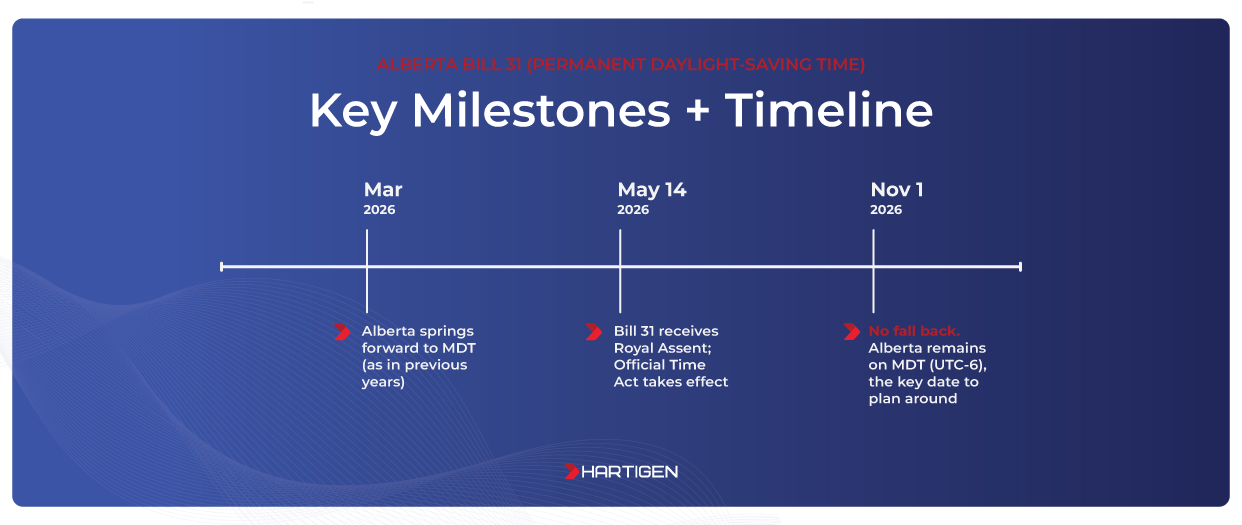
Bill 31 is now law. Alberta's move to permanent Mountain Daylight Time (UTC-6) received Royal Assent on May 14, 2026, under the new Official Time Act.
No clock change this fall. Alberta will not "fall back" on November 1, 2026; the March 2026 shift to MDT will be the province's final clock change.
Now's the time to check your own systems. Any process that branches logic based on seasonal DST changes, load forecasting, bid submission windows, or interval timestamping, should be reviewed before November 1, 2026 to confirm it won't expect a fall back that isn't coming.
About the Market Change
Bill 31 officially received Royal Assent on May 14, 2026, legally cementing the province's transition to permanent Mountain Daylight Time (UTC-6). The province is branding this year-round schedule "Alberta Time," a single, fixed standard that retires the twice-yearly clock changes many of us have built habits and systems around for years.
To be clear on the mechanics: Alberta already sprang forward in March 2026, as it has every year. What's different is what doesn't happen next, there will be no fall back on November 1, 2026. From that point forward, Alberta will remain fixed at UTC-6.
We know changes like this can feel like a lot to track on top of everything else on your plate, so our goal with this update is simple: give you a clear, no-surprises picture of what's changing, well ahead of the date that matters.
Why it Matters
We've seen firsthand how deeply time-of-use assumptions are woven into market operations, from load forecasting to bid submission windows to interval timestamping. Any process that currently branches logic based on DST transitions (a "short day" in spring, a "long day" in fall) deserves a second look before November.
Left unaddressed, this kind of structural shift could quietly introduce:
Misaligned settlement intervals around the November 1, 2026 transition date
Timestamp discrepancies between Alberta and neighboring jurisdictions that continue observing DST
Downstream reconciliation issues in load and submission data
What’s Driving the Change
Bill 31 grew out of Alberta's broader red tape reduction agenda, aimed at simplifying regulatory and administrative processes for residents and businesses across the province. Moving to a single, permanent time standard removes the operational overhead, and the twice-yearly disruption, that comes with maintaining separate standard and daylight time schedules. It's a modernization effort on the province's part, and one we think is worth understanding at the source rather than secondhand.
How to Prepare
We'd rather walk through this with you now than have you find a gap later, so here's where we'd suggest starting:
Audit DST-dependent logic. Take stock of any system, script, or process on your side that currently accounts for "long" or "short" days around the historical DST transition dates.
Plan a check-in around November 1, 2026. We'd suggest treating this as a light validation checkpoint on your side, just to confirm nothing in your system/s is still expecting a fall back.
Loop in cross-jurisdictional partners. If you operate across time zones or interface with markets that still observe DST, it's worth flagging the divergence internally to avoid timestamp mismatches after November 1.
None of this needs to happen all at once, and if it's helpful, we're glad to talk through your specific setup rather than leave you to interpret this alone.
Additional Considerations
Cross-border/cross-jurisdiction alignment: Neighboring provinces and U.S. states may continue observing standard DST changes, meaning Alberta's relative offset to those regions will still shift twice a year, even though Alberta's own clock stays fixed. Worth accounting for in any multi-jurisdictional reporting or settlement.
Historical data handling: We'd recommend making sure historical timestamp data (pre-transition) isn't retroactively reinterpreted under the new fixed offset, clear versioning or documentation of the cutover point goes a long way for future audits or analysis.
Vendor and third-party systems: It's worth double-checking that any external vendor tools, APIs, or data feeds referencing Alberta time zones are also updated to reflect the permanent UTC-6 standard.
Internal communication: Since this is a legislative and structural change rather than a routine software update, a short plain-language briefing for teams outside IT/market operations can go a long way in avoiding confusion down the line.
Resources
For more information on Alberta Bill 31, please refer to:
Hartigen’s Role
Market changes like this one are constant across ISO/RTO markets and staying ahead of them without disrupting your operations is exactly what PowerOptix® is built to do. Rather than leaving customers to track, interpret, and implement every version update on their own, Hartigen continuously monitors evolving market rules and builds the corresponding updates directly into the platform.
For the Alberta Bill 31 transition, the necessary changes were incorporated in our August 28 PowerOptix release 2026.8.1, so customers can stay current without taking on the technical burden themselves. It’s a core part of what sets PowerOptix apart, a platform designed to keep pace with the market, so your team doesn’t have to. Learn more, here.
Stay Ahead of Market Change
If you have questions about how this transition may affect your integrations, or want help planning your MTE testing timeline, reach out to your Hartigen representative.
References
Content in Volume 8 of the ISO Market Edge, reflects Hartigen’s internal expertise, with significant contributions from our AESO expert, Emilo Torres, and our director of product development, Rashmi Karnik.