
How ISO Settlements Work: A Practical Guide for Energy Market Participants
ISO settlements are the financial backbone of wholesale electricity markets. After electricity is bought, sold, and delivered across the grid, settlement systems determine who gets paid, how much they receive, and what each market participant owes.
Independent System Operators (ISOs) and Regional Transmission Organizations (RTOs), including PJM, MISO, ERCOT, CAISO, and ISO New England, run these settlement processes to reconcile market activity with real-world grid operations. Because electricity markets operate continuously and involve thousands of transactions every day, the settlement process plays a crucial role in maintaining transparency, reliability, and financial accuracy across the power system.
For companies participating in wholesale power markets, such as utilities, independent power producers, and energy traders, understanding how ISO settlements work is essential. Settlement outcomes directly impact revenue, operating costs, financial reporting, and risk management.
“Even small discrepancies in settlement calculations can translate into significant financial exposure when operating at the scale of modern electricity markets.”
This guide explains how ISO settlements work, answers the most common questions about settlement processes, and explores how modern settlement platforms help energy companies manage complex market data more efficiently.
What Are ISO Settlements?
ISO settlements are the financial reconciliation process used by wholesale electricity markets to calculate payments and charges for generators, utilities, and traders based on actual grid activity and market prices.
Settlement systems evaluate multiple factors, including:
Electricity generated and consumed
Market clearing prices
Transmission congestion
Ancillary services provided
Deviations between scheduled and actual power
Using this information, the ISO calculates financial charges and credits for each market participant after the operating day. The result is a detailed settlement statement that shows how much each organization owes or is owed based on its participation in the market.
This process ensures that electricity markets operate fairly and transparently. Market participants are compensated based on the electricity they actually generate or consume, rather than solely on scheduled transactions. Settlement calculations also enforce market rules and maintain accountability across all participants.
According to the Federal Energy Regulatory Commission (FERC), settlement systems are essential for ensuring that market participants are credited and charged accurately based on market rules and verified operational data (FERC, 2024).
Why ISO Settlements Exist
Electricity markets are fundamentally different from many other commodity markets. Unlike commodities such as oil or natural gas, electricity cannot easily be stored in large quantities. Supply and demand must remain balanced at all times in order to maintain grid stability.
ISOs coordinate this balance by managing generation dispatch, monitoring transmission flows, and operating organized wholesale markets where electricity is bought and sold. However, once electricity has been delivered across the grid, all of the operational activity must be translated into financial transactions. This is the purpose of the settlement process.
ISO settlements ensure that generators are paid for the electricity they produce and that utilities or load-serving entities pay for the energy they consume. They also ensure that market participants are financially responsible for deviations from their schedules, such as producing less power than committed or consuming more energy than forecasted.
Without settlement systems, it would be extremely difficult to reconcile the enormous number of transactions that occur in electricity markets each day. Thousands of generators and loads interact across complex transmission networks, and prices vary by location and time. Settlement systems provide the structured financial framework needed to translate this operational complexity into accurate financial outcomes.
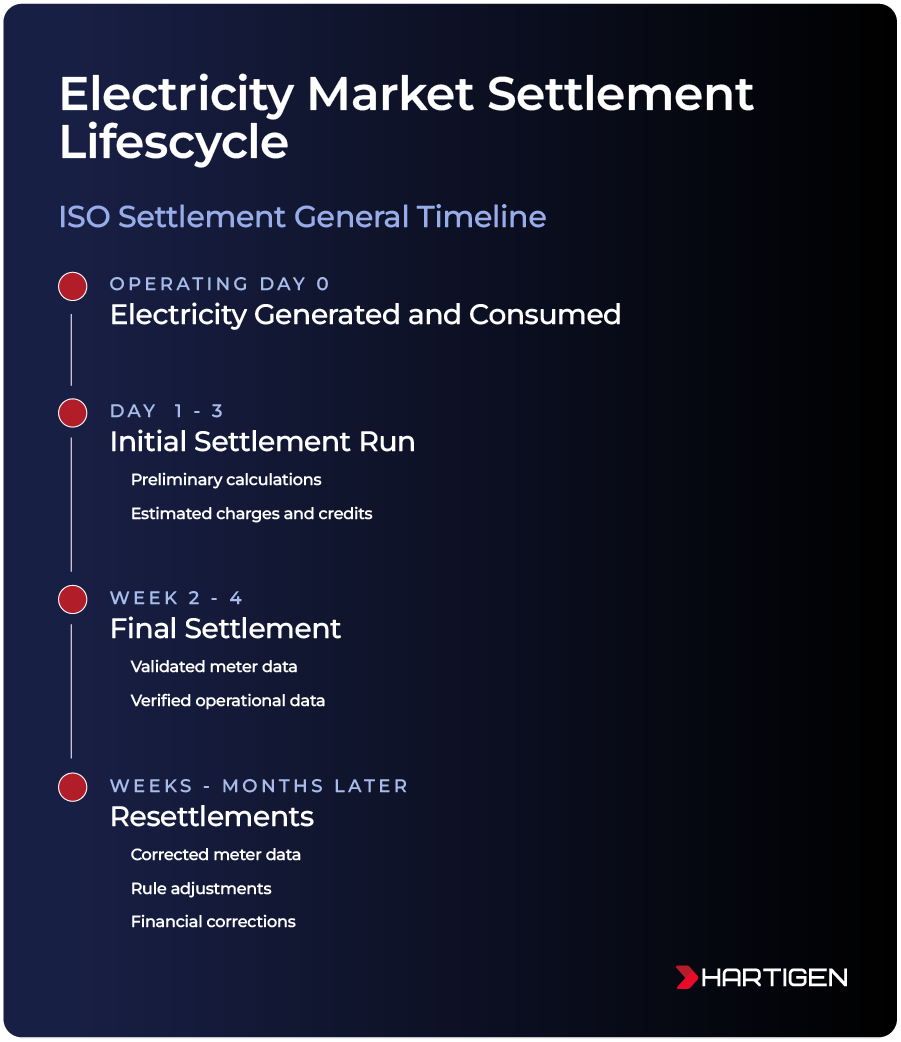
Electricity Market Settlement Lifecycle
How ISO Settlements Work
The ISO settlement process unfolds in several stages that connect market activity with financial outcomes. These stages occur over multiple days or weeks as operational data becomes available and settlement calculations are validated.
Market Participation and Scheduling
The settlement process begins with market participation. Generators, utilities, and other market participants submit bids and offers into wholesale electricity markets operated by the ISO.
Generators indicate how much electricity they are willing to produce and the price at which they are willing to sell it. Utilities and load-serving entities submit bids to purchase electricity in order to meet the demand of their customers. Energy trading firms may also participate by buying and selling contracts to hedge price risk or capture market opportunities.
Most ISO markets operate both a day-ahead market and a real-time market.
In the day-ahead market, participants schedule electricity production and consumption one day before the operating day. The ISO uses these bids to determine which generators will run and how electricity will flow across the grid. Day-ahead scheduling allows grid operators to plan generation commitments and maintain reliability.
However, actual system conditions rarely match forecasts exactly. Demand may fluctuate due to weather changes, unexpected equipment outages may occur, or transmission constraints may alter power flows. To account for these changes, the real-time market adjusts schedules continuously throughout the operating day.
These market activities form the foundation of settlement calculations.
Dispatch and Market Pricing
After market bids are submitted, the ISO dispatches generators in order to meet electricity demand while maintaining system reliability. Dispatch decisions consider multiple factors, including generation costs, transmission constraints, and reliability requirements.
Wholesale electricity prices are typically determined using Locational Marginal Pricing (LMP). LMP reflects the cost of delivering electricity to a specific location on the grid. The price incorporates three primary components: the cost of generating electricity, the cost of transmission congestion, and the cost of energy losses during transmission.
Because electricity flows through a complex network of transmission lines with physical constraints, prices often vary across different nodes or zones on the grid. For example, areas experiencing transmission congestion may see significantly higher prices than areas with abundant generation and available transmission capacity.
These location-based prices are critical inputs to the settlement process because they determine how much electricity buyers pay and how much generators receive for their production (FERC, 2023).
Meter Data and Operational Verification
Once electricity has been generated and delivered, the ISO collects operational data from across the grid. Metering systems record the amount of electricity produced by each generator and the amount consumed by loads.
Meter data also captures power flows across transmission infrastructure and verifies the actual performance of market participants. This information is essential because settlement calculations must reflect what actually occurred on the grid rather than what was scheduled in the market.
Meter validation and data verification are important parts of this stage. Data must be checked for accuracy and consistency before it is used in settlement calculations. Any discrepancies or errors may lead to adjustments during later settlement runs.
Initial Settlement Calculations
Shortly after the operating day, the ISO performs preliminary settlement calculations using the available operational data. These early settlement runs estimate the financial charges and credits associated with market participation.
Initial settlements help market participants evaluate their financial exposure and begin internal reconciliation processes. Energy companies typically compare ISO settlement statements with their internal generation records, trading positions, and financial systems to ensure that the calculations align with their expectations.
Because some operational data may still be undergoing validation, these early settlement calculations are typically considered preliminary.
Final Settlements and Resettlements
As additional data becomes available and operational information is verified, ISOs perform final settlement calculations.
Final settlements incorporate validated meter data, updated system information, and any adjustments required by market rules. These calculations provide the official financial outcomes for the operating day.
In many markets, additional settlement runs known as resettlements occur weeks or months after the original operating day. Resettlements incorporate corrected data, revised calculations, or rule-based adjustments that were not included in earlier settlement runs.
While resettlements ensure financial accuracy, they also create operational challenges for market participants. Companies must continue monitoring settlement statements long after the operating day to reconcile any adjustments that occur during these later settlement cycles.
Key Components of ISO Settlement Calculations
ISO settlement calculations involve many different financial components that reflect the complexity of electricity markets.
The largest component is typically the energy charge, which reflects the market price of electricity delivered at a specific location on the grid. However, several additional charges may appear in settlement reports depending on market conditions and participation.
Congestion charges represent the cost of transmission constraints when electricity cannot flow freely across the grid. Loss charges account for energy that is lost during transmission. Payments for ancillary services compensate generators that provide reliability services such as operating reserves, voltage support, or frequency regulation.
Some markets also include financial instruments such as Financial Transmission Rights (FTRs) or congestion hedges that affect settlement outcomes.
Because each ISO defines settlement charge codes differently, companies operating in multiple markets must manage a variety of settlement structures and reporting formats.
Shadow Settlements: Verifying ISO Financial Outcomes
One important concept in modern electricity market operations is shadow settlements.
A shadow settlement is an internal calculation performed by a market participant to independently replicate or approximate the ISO’s official settlement results. Instead of relying solely on ISO invoices, organizations run their own settlement models using market data, meter readings, and pricing information.
The goal of shadow settlements is to validate that the ISO’s calculations are correct and consistent with market rules. If discrepancies appear between a company’s shadow settlement and the official ISO settlement statement, the organization can investigate the difference and determine whether an error occurred.
Shadow settlements are particularly valuable for companies operating at scale because even small discrepancies in settlement calculations can represent significant financial impact. By replicating settlement calculations internally, organizations gain greater transparency into how settlement outcomes are generated.
Shadow settlement processes often involve reconstructing energy charges, congestion costs, ancillary service payments, and other settlement components using available market data.
However, building accurate shadow settlement models can be extremely complex. Each ISO market has unique settlement charge codes, calculation methodologies, and rule structures that evolve over time. Maintaining internal models that track these changes can require significant technical and operational effort.
How Hartigen Approaches Shadow Settlements
Hartigen approaches shadow settlements by combining automated data ingestion, settlement modeling, and reconciliation workflows within a unified platform.
Instead of requiring companies to build and maintain custom settlement models from scratch, Hartigen’s PowerOptix platform provides the infrastructure needed to replicate and validate settlement calculations across multiple ISO markets. The system ingests ISO data feeds, market prices, meter data, and settlement statements to construct a shadow view of settlement outcomes.
By comparing internal shadow calculations against official ISO settlements, the platform helps organizations identify discrepancies earlier in the settlement lifecycle. This allows teams to investigate unexpected charges, validate settlement accuracy, and resolve issues before they become larger financial problems.
“Hartigen’s approach also focuses on scalability. ”
Because companies often operate across several ISO markets simultaneously, the platform is designed to support multiple settlement structures and evolving market rules. Automated reconciliation workflows help teams quickly pinpoint the source of differences between shadow settlements and official ISO statements.
For utilities, power producers, and energy trading firms, shadow settlement capabilities provide an additional layer of financial assurance. Instead of reacting to settlement results after invoices arrive, organizations gain the ability to proactively validate settlement outcomes and monitor financial exposure throughout the settlement cycle.
Why ISO Settlements Are Operationally Challenging
Managing ISO settlements can be extremely challenging for energy companies because of the scale and complexity of settlement data.
Wholesale electricity markets generate large settlement reports containing detailed calculations, hundreds of charge codes, and multiple settlement runs. These reports must be reconciled against internal trading records, generation data, and financial accounting systems.
Each ISO also publishes settlement data in different formats and on different timelines. Organizations participating in multiple markets must navigate several reporting structures and rule sets simultaneously.
Resettlements introduce another layer of complexity. Financial adjustments may occur weeks or months after the original settlement run, requiring companies to continually monitor updated statements and reconcile changes.
Without automated tools, many organizations rely heavily on spreadsheets and manual workflows to manage this process. As market data volumes grow, these manual approaches become increasingly difficult to maintain.
Why Energy Companies Are Automating Settlement Management
As electricity markets evolve and become more data-intensive, settlement automation is becoming increasingly important for market participants.
Automated settlement systems allow organizations to process large volumes of market data more efficiently. They help reconcile settlement statements quickly, detect discrepancies earlier, and reduce the operational burden of manual reconciliation. Automation also improves financial visibility. Companies can gain deeper insights into market performance, settlement trends, and operational risks. This visibility supports better decision-making and more accurate financial reporting.
For organizations operating across multiple ISO markets, automated settlement platforms provide a scalable solution for managing complex settlement workflows.
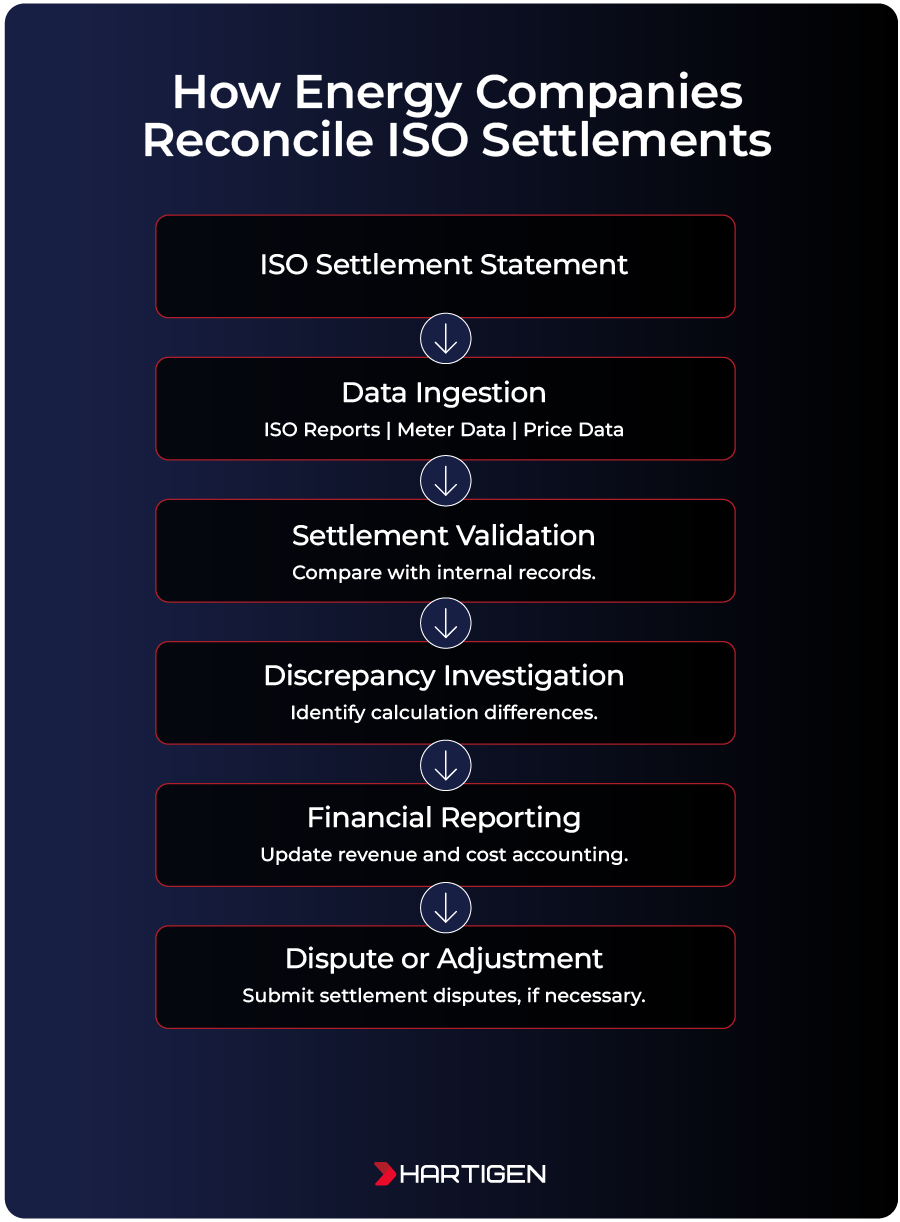
ISO Settlement Statement Workflow Diagram
How Hartigen Helps Companies Manage ISO Settlements
Hartigen provides settlement capabilities within the PowerOptix platform designed to simplify settlement management for energy market participants.
PowerOptix helps companies automate settlement reconciliation, validate ISO settlement statements, and identify discrepancies across market reports. By centralizing settlement data and automating complex reconciliation workflows, Hartigen enables organizations to reduce reliance on spreadsheets and manual processes.
PowerOptix also improves transparency across settlement operations. Teams can quickly analyze settlement outcomes, investigate discrepancies, and generate financial reports that support internal decision-making.
For utilities, power producers, and energy trading firms, this approach reduces operational risk while improving confidence in settlement outcomes.
Instead of manually reviewing large settlement datasets across multiple ISO systems, organizations can use PowerOptix to streamline reconciliation and gain clearer insights into their settlement performance.
Frequently Asked Questions About ISO Settlements
What is ISO settlement in electricity markets?
ISO settlement is the financial process used by wholesale electricity markets to calculate payments and charges for generators, utilities, and traders based on actual electricity generation, consumption, and market prices.
How long do ISO settlements take?
Initial settlement calculations typically occur within a few days of the operating day. However, final settlements and resettlements may occur weeks or months later as operational data is validated and corrections are applied.
What is a resettlement in power markets?
A resettlement is a revised settlement calculation that occurs after the initial settlement run. It incorporates updated operational data, corrected meter readings, or rule-based adjustments to ensure financial accuracy.
Why are electricity market settlements complex?
Electricity market settlements are complex because they must account for location-based prices, transmission constraints, deviations between scheduled and actual power, and multiple market products such as ancillary services.
What tools help companies manage ISO settlements?
Many organizations use specialized energy settlement platforms to automate reconciliation, analyze settlement data, and manage financial reporting across multiple electricity markets.
Final Thoughts
ISO settlements are one of the most critical processes in wholesale electricity markets. They transform the operational activity of the power grid into financial transactions that ensure every participant is compensated fairly based on actual system conditions.
However, the complexity of modern electricity markets means settlement management involves large datasets, multiple settlement runs, and highly detailed market rules.
As market participation expands and settlement data continues to grow, energy companies increasingly rely on advanced settlement platforms, such as Hartigen’s settlement solution, to streamline reconciliation, detect discrepancies earlier, and improve financial confidence in market outcomes.
SOURCES
Federal Energy Regulatory Commission (FERC). Regional Transmission Organizations (RTOs) and Independent System Operators (ISOs).
https://www.ferc.gov/power-sales-and-markets/rtos-and-isos
ISO New England. Settlements and Billing Overview.
https://www.iso-ne.com/markets-operations/settlements
EUCI. ISO Market Settlements Fundamentals.
https://www.euci.com/pdf/0321-iso-market-settlements.pdf
Oracle Energy & Water. Understanding Market Settlements.
https://docs.oracle.com/en/industries/energy-water/market-settlements-management
Wikipedia. Electricity Market
https://en.wikipedia.org/wiki/Electricity_market