
What Is SPP Markets+? A Complete Guide for ISO/RTO Participants
SPP Markets+ is Southwest Power Pool’s (SPP) Western day-ahead and real-time market offering is positioned as a “bundle of services” that centralizes day-ahead and real-time unit commitment and dispatch to support reliability and the integration of a growing renewable fleet. (spp.org)
If you already participate in an ISO/RTO market (or you trade actively across ISO/RTO seams and bilateral corridors), Markets+ matters for one big reason: it’s part of the West’s shift from largely bilateral scheduling toward more centralized optimization, which changes how value is created (and captured) in day-ahead schedules, congestion management, imbalance, and settlements.
This guide is written for:
ISO/RTO participants evaluating Western expansion or increased West-to-RTO interchange
Bilateral power market participants preparing for centralized day-ahead coordination
Utilities and public power entities planning governance, onboarding, and market-readiness workstreams
What is Markets+?
Markets+ is SPP’s FERC-approved proposal to operate a centralized day-ahead market and associated real-time market services in the Western Interconnection, with a current target of an October 2027 go-live for entities that meet key registration deadlines. (spp.org)
That “go-live window + deadlines” detail is not marketing fluff; it’s operationally binding. SPP has explicitly tied inclusion in the October 2027 go-live to participant registration deadlines (with different dates for balancing authorities, transmission service providers, and market participants). (spp.org)
A Brief History of Markets+
Markets+ didn’t appear overnight. It’s the latest step in a Western market evolution that has intentionally moved in stages rather than via a single, region-wide “big bang” transition to an ISO/RTO model. FERC’s explaineremphasizes that the West has historically relied on a mix of bilateral trading and coordinated regional real-time markets, and that newer market initiatives have gradually expanded centralized optimization across a broader footprint.
A key inflection point in that progression was the rise of regional real-time imbalance markets. In 2014, CAISOlaunched the Western Energy Imbalance Market (WEIM)to expand real-time market access to utilities outside CAISO’s balancing authority areas, enabling broader least-cost dispatch and improved reliability across participating entities. Over time, WEIM grew significantly across the Western Interconnection, reflecting the West’s appetite for regional optimization without requiring every participant to become part of a multi-state ISO/RTO.
SPP’s western story followed a similar arc. FERCnotes that SPP, originally formed in 1941 as a power pool and later achieving RTO status in 2004, has long been a major organized-market operator, primarily in the central U.S., but increasingly active in Western initiatives as well. That Western engagement accelerated when, in 2020, SPP established the Western Energy Imbalance Service (WEIS) market to provide real-time market access to Western utilities that are not members of the SPP RTO, again combining centralized real-time balancing with the continued ability to transact bilaterally.
“From that foundation, Markets+ can be understood as the next evolutionary step: moving beyond real-time imbalance and toward a more fully integrated Western market construct. ”
In FERC’s explainer, Markets+ is positioned as part of the broader Western market expansion story, with the Commission noting that in January 2025, FERC approved SPP’s Markets+ proposal (subject to condition), regulatory milestone that shifted Markets+ from concept to implementation reality.
Why Markets+ Exists: The West is Entering a “Two-Day-Ahead-Market” Era
The Western Interconnection is reorganizing around two voluntary day-ahead market paths:
CAISO EDAM (Extended Day-Ahead Market)
SPP Markets+
Industry observers describe this as a structural change aimed at “taming the Wild West” of fragmented bilateral coordination because the day-ahead timeframe is where you can most efficiently allocate transmission, commit resources, and reduce uneconomic curtailment before real-time volatility hits. (Grid Status Exports)
For ISO/RTO participants, the “West” may feel external, but Markets+ affects:
Interregional trading opportunities and constraints (contract path + flow impacts)
Seams and congestion dynamics that feed into schedules and imbalance
Resource adequacy and forward operational commitments for utilities with Western exposure
IT/market operations if you participate directly or through counterparties
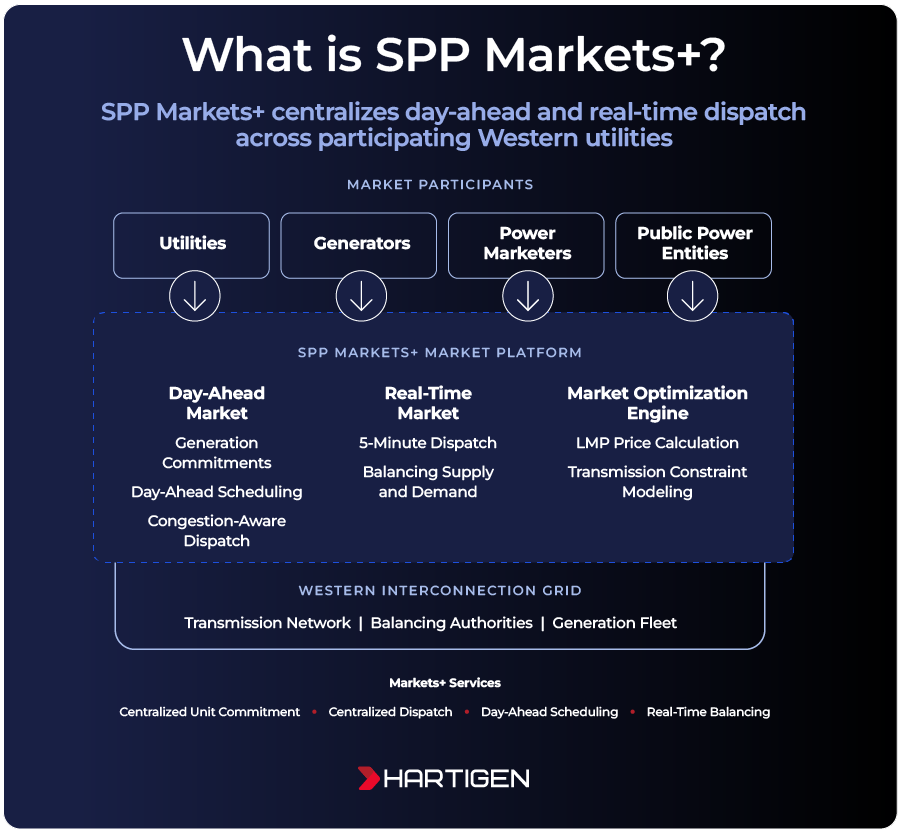
SPP Markets+ centralizes day-ahead and real-time dispatch across participating Western utilities.
The Regulatory Milestone: FERC Accepted the Markets+ Tariff (with conditions)
Markets+ is not just an initiative; it’s a tariffed market construct under FERC jurisdiction.
On January 16, 2025, FERC issued an order accepting SPP’s proposed Markets+ tariff, subject to condition (Docket ER24-1658). (spp.org)
FERC’s published meeting materials also summarize that the tariff was accepted with a requirement for a compliance filing within 30 days.
This matters because it moved Markets+ from “concept + stakeholder process” into “implementation program with an enforceable framework.” SPP itself framed this approval as the key milestone enabling phase-two work once funding commitments were executed. (spp.org)
Markets+ Timeline and Phases
SPP’s Markets+ materials describe the program as being in Phase Two – Implementation and instruct potential participants to begin onboarding via SPP’s RMS ticketing process. (spp.org)
Two timeline signals are especially important:
1) October 2027 go-live (for entities meeting deadlines)
SPP’s Markets+ page states that indicating intent to participate by listed deadlines is “essential to ensure inclusion in the October 2027 go-live.” (spp.org)
2) Phase-two development financing ($150M)
SPP announced it entered phase two with secured financing for $150 million needed for full implementation.
If you’re used to ISO/RTO timelines, this should feel familiar: once financing and tariff authority are in place, the long pole becomes implementation detail: systems, telemetry, modeling, training, parallel ops, and cutover readiness.
Who is Participating? (A Practical Signal for Market Direction)
Markets+ publishes a current “Phase Two participants” list (as of October 27, 2025) that includes a mix of investor-owned utilities, public power, and federal marketing/transmission entities. (spp.org)
The posted Phase Two participant list includes:
Arizona Public Service, Bonneville Power Administration, Chelan County PUD, Grant County PUD, Powerex, Puget Sound Energy, Salt River Project, Tacoma Power, Tucson Electric Power, and Xcel/Public Service Company of Colorado. (spp.org)
Separately, SPP and industry coverage have discussed commitments tied to phase-two financing and development work, reflecting how entities are moving from “stakeholder interest” to “funded implementation participation.” (publicpower.org)
Why ISO/RTO participants should care: participant mix influences liquidity, congestion patterns, and the diversity benefits that drive day-ahead savings. In practice, the scale and composition of the participating footprint will play a major role in determining how much operational and economic value the market can deliver.
What Markets+ Actually Does: Day-Ahead and Real-time, Centralized Commitment and Dispatch
SPP characterizes Markets+ as a bundle of services that centralizes:
Day-ahead unit commitment and dispatch
Real-time unit commitment/dispatch functionality as part of its offering design (spp.org)
Even if you’ve lived in ISO/RTO markets for years, it helps to translate Markets+ into “functional blocks” that map to your existing playbook:
Day-ahead market (DAM): the center of gravity
In organized markets, the DAM is where participants convert forecasts and contracts into:
Financially binding positions
Commitment decisions that reduce real-time scarcity
Cleared schedules that shape congestion outcomes
Markets+ is explicitly positioned as a day-ahead market for the West and early reporting around the tariff filing highlighted that it sets forth responsibilities and the operation, pricing, and settlement of both the day-ahead and real-time balancing market. (utilitydrive.com)
Real-time balancing market: volatility management, not just cleanup
For ISO/RTO participants, real-time is where forecast error becomes dollars. Markets+ is designed to extend centralized coordination beyond “imbalance-only” by pairing day-ahead with real-time market services. (spp.org)
Markets+ vs. WEIS: What Changes if You Already Know SPP Western Services?
Many Western entities are familiar with SPP’s Western Energy Imbalance Service (WEIS), which began operations in 2021 as a real-time wholesale imbalance market. (WECC)
“WECC’s State of the Interconnection materials summarize that WEIS is a real-time market that began operations in 2021, and they describe Markets+ as building on that foundation by adding day-ahead and related services.”
The key shift is timing and commitment:
Imbalance markets help optimize 5-minute/real-time deviations
Day-ahead markets optimize the system before the operating day, when you can still commit resources and allocate transmission more efficiently
That “day-ahead advantage” is why Markets+ is strategically important even for entities that already have an imbalance market solution.
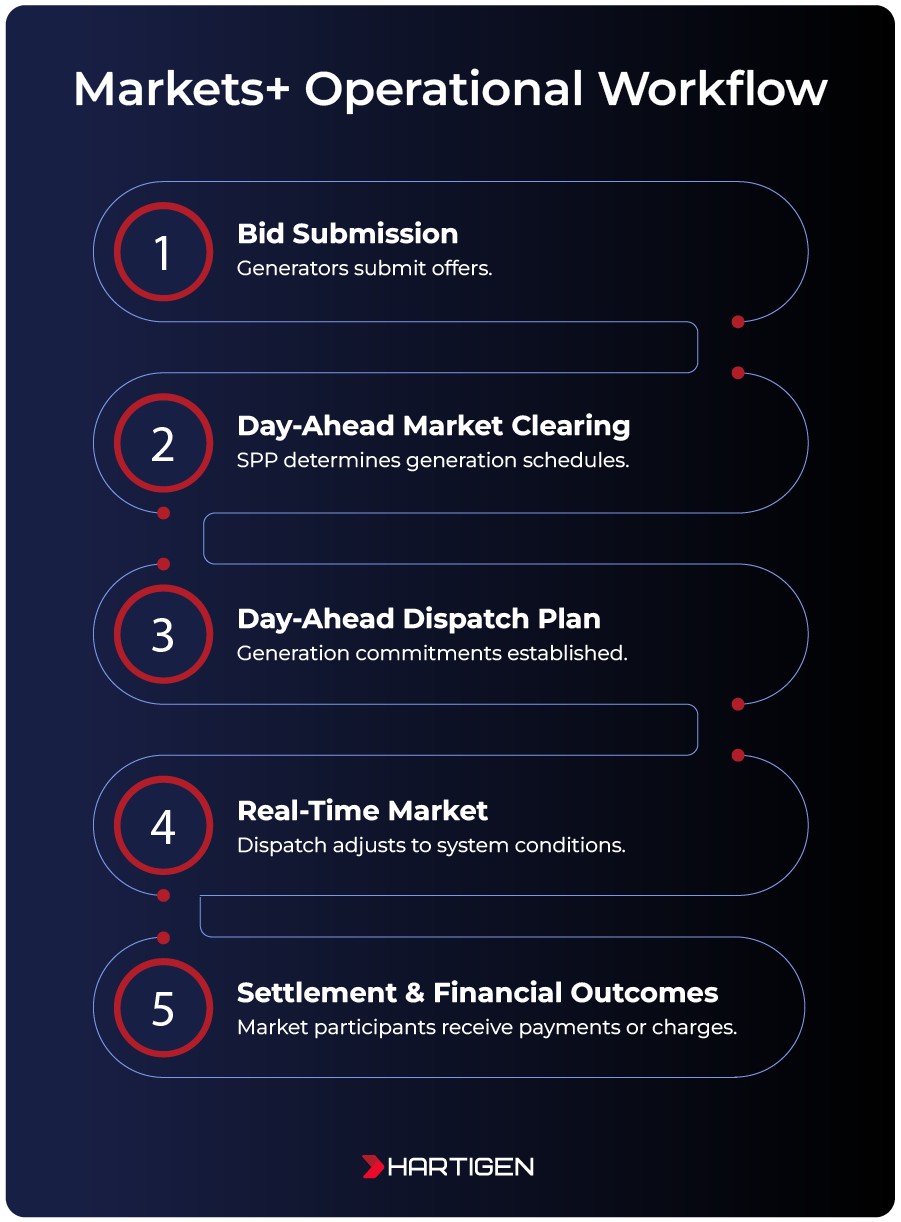
Operational Workflow in Markets+
SPP’s Market Monitoring Unit said in its spring 2025 WEIS Quarterly State of the Market report that SPP plans to terminate the Western Energy Imbalance Service (WEIS) on April 1, 2026 as Western balancing authorities transition into the SPP Integrated Marketplace.
The MMU’s point was not just that WEIS is ending, but that the timeline leaves limited runway for major new market design changes before the service sunsets. Even so, the MMU said targeted improvements that strengthen reliability, transparency, and operational efficiency should still be pursued where needed, because those fixes can benefit participants during the transition and help inform long-term operating practices in the West.
That transition is tied to SPP’s broader Western RTO expansion. After FERC approved SPP’s amended tariff in March 2024, SPP said the order cleared the way for seven Western entities, all current WEIS participants, to begin taking service under the Integrated Marketplace, transmission planning, reliability coordination, and other RTO functions starting in April 2026. In other words, the planned WEIS termination is not being framed as a standalone shutdown; it is part of a broader migration from a voluntary real-time imbalance market into SPP’s full RTO market structure for at least part of the Western footprint.
There is also an important market-structure angle here. The MMU notes that WEIS includes service flow constraints and energy imbalance constraints that are unique to WEIS and are not part of the SPP Integrated Marketplace. That means the April 2026 transition is not simply a change in name or governance; it represents a shift into a different operating and congestion-management framework with broader market services, including day-ahead functionality available through the Integrated Marketplace.
At the same time, SPP’s separate Markets+ effort remains on a later timeline, with SPP stating that Markets+ is expected to go live in October 2027 for participants that met key registration deadlines. (spp.org)
The Design Questions ISO/RTO Participants Ask First
If you’ve participated in PJM/MISO/SPP (Integrated Marketplace)/ISO-NE/NYISO/ERCOT, your instincts are right: market design details can materially affect outcomes. But in the West, a lot of debate is really about seams, transmission rights, and footprint composition.
Here are the design topics that show up most in stakeholder conversations and why they matter to ISO/RTO participants evaluating cross-market exposure:
Flow-based optimization vs. contract-path realities
The West has deep contract-path history. Both EDAM and Markets+ are expected to operate in an environment where optimization must coexist with existing transmission rights and contract path constraints.
Why it matters: if you transact across West-to-RTO seams, or you manage a portfolio with long transmission legs, the treatment of contract-path constraints affects deliverability assumptions and congestion outcomes that feed into price and hedging.
Real-time unit commitment and “look-ahead” capability
Differences in real-time commitment tools and look-ahead capability can influence how efficiently markets respond to changing system conditions.
Why it matters: those differences can affect scarcity pricing patterns, uplift-like effects, imbalance risk management, and short-term hedging decisions.
Governance and participant influence
Markets+ moved into phase-two governance structures, including a Participant Executive Committee (MPEC) and working groups, as the program entered implementation. (spp.org)
Why it matters: if you may participate directly (or your counterparties will), governance determines how quickly operational rules stabilize and how much change risk you carry into launch.
Participation Types and What “Joining” Really Entails
“Joining a market” is never one decision. For most utilities and market participants, it’s a chain of decisions that look like:
Governance participation (influence design direction)
Funding/implementation commitments (pay for build + access testing)
Operational participation (register assets, model network, establish settlements + credit)
Go-live readiness (training, parallel ops, cutover)
SPP and public-power coverage emphasize that phase-two participation and financing commitments are separable concepts: some entities commit to governance seats and voting, while funding/participation commitments are another step. (publicpower.org)
Key onboarding and registration milestones (why you can’t “wait until 2027”)
SPP’s Markets+ page explicitly lists key registration deadlines tied to being included in the October 2027 go-live, including:
Balancing Authorities: September 1, 2025
Transmission Service Providers: October 1, 2025
Market Participants: April 1, 2026 (spp.org)
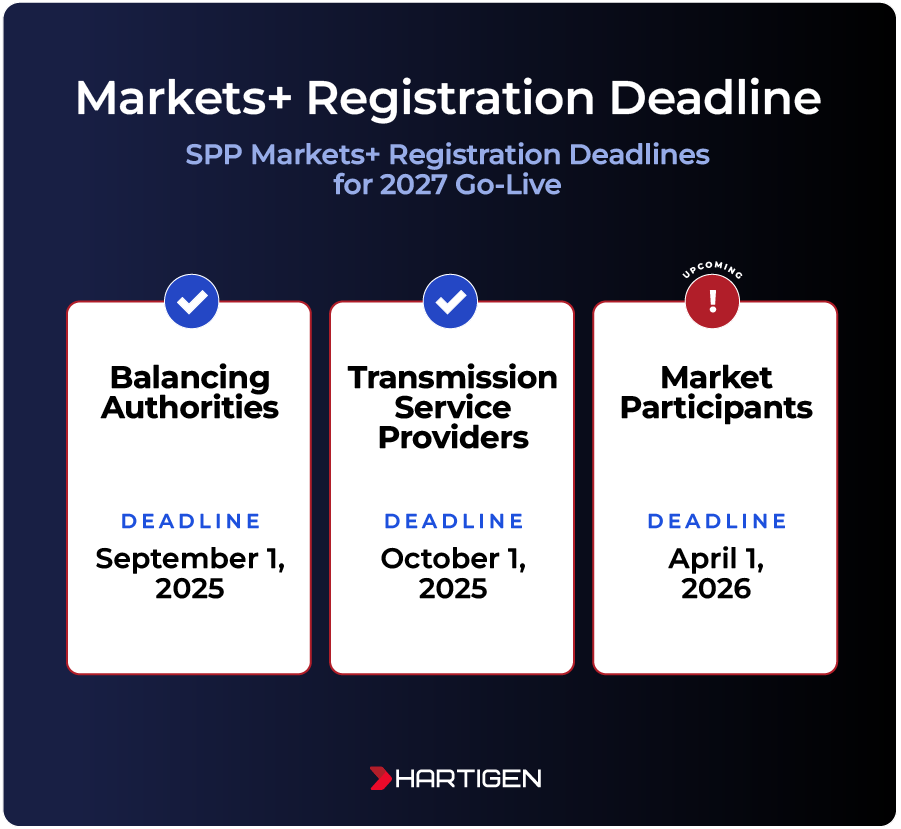
Markets+ Registration Deadlines for 2027 Go-Live
If you’re an ISO/RTO participant reading this and thinking “those dates are in the past and/or soon,” that’s exactly the point: centralized markets force earlier internal alignment because systems and protocols must be tested well ahead of cutover.
What Changes for Bilateral Power Market Participants?
Markets+ doesn’t eliminate bilateral contracting. What it changes is how bilateral positions translate into:
Day-ahead schedules
Congestion and deliverability outcomes
Imbalance exposure
Settlement mechanics
In every organized market, the “contract + schedule + hedge” workflow becomes more formalized under tariff rules. Early coverage of the tariff filing highlighted that Markets+ tariff language describes bidding/offering/dispatch responsibilities and outlines pricing and settlement for both day-ahead and real-time market operation.(utilitydive.com)
The Practical Impacts You Should Model Now
If your business is bilateral-first, Markets+ readiness tends to cluster into four workstreams:
Forecast-to-bid discipline. More centralized day-ahead means you need tighter load/resource forecasting and clearer decision rights for self-schedule vs. economic offer.
Transmission and rights mapping. Contract path constraints, rights donation concepts, and congestion allocation rules become market inputs, not after-the-fact settlement surprises.
Settlement and dispute readiness. DAM + RT settlement complexity generally rises, especially around deviations, uninstructed imbalance, and congestion revenue allocation.
Seams strategy. If you move power between Markets+ and an ISO/RTO footprint (or between Markets+ and another Western construct), seams management becomes a profit center or a recurring pain point.
How Markets+ Interacts with the Broader Western Market Evolution (EDAM, WEIM, WEIS)
One reason Markets+ is frequently discussed alongside CAISO EDAM is that both aim to extend market benefits into the day-ahead timeframe across a wider Western footprint. Industry analysis frames this as competing constructs that may reshape trading patterns and operational coordination across the West. (gridstatus.io)
If you’re advising a trading desk or utility leadership, a useful way to think about the decision is not “which market is better in theory,” but:
Where will your physical footprint and counterparties be?
Which construct best matches your transmission topology and rights position?
Which market reduces your curtailment + imbalance costs given your renewable mix?
Which implementation path minimizes change risk (systems + process + governance stability)?
A Market-Readiness Checklist
Most organizations underestimate how much “invisible plumbing” sits between a tariff and operational participation. Here’s the narrative version of what mature readiness looks like:
1) Data readiness: your model must match the market’s model
ISO/RTO participants already know this: bad asset data becomes bad commitment decisions, bad settlements, and bad disputes. Markets+ implementation includes onboarding and registration steps; SPP instructs potential participants to begin via formal onboarding channels. (spp.org)
2) Process readiness: decision rights beat heroics
Centralized day-ahead requires clear ownership for:
Self-scheduling vs. economic offers
Outage and derate workflows
Interchange scheduling
Congestion/hedge strategy
3) Systems readiness: integration is not optional
Even in mature ISOs, market integration work often defines the critical path. Public reporting has highlighted that Markets+ implementation includes system development, testing, and parallel operations. (spp.org)
4) Governance readiness: change keeps coming after go-live
Markets+ has established phase-two governance structures to guide implementation. (spp.org)
If you participate (or your counterparties do), you’ll need an internal mechanism to track stakeholder changes and convert them into config and process updates fast.
Frequently Asked Questions
When is Markets+ expected to launch?
SPP has stated Markets+ is expected to go live in 2027, and its Markets+ program page ties inclusion in the October 2027 go-live to specific registration deadlines.Is Markets+ “just a day-ahead market”?
SPP describes Markets+ as more than just a day-ahead market offering. Markets+ is a bundle of services that centralizes day-ahead and real-time unit commitment and dispatch.Did FERC approve Markets+?
Yes. FERC issued an order on January 16, 2025 accepting the proposed tariff, subject to condition, in Docket ER24-1658.Who’s in Markets+ today?
Markets+ publishes a Phase Two participant list (as of October 27, 2025). The list includes APS, BPA, Chelan PUD, Grant PUD, Powerex, Puget Sound Energy, SRP, Tacoma Power, TEP, and Xcel/Public Service Company of Colorado, among others. (spp.org)
How Hartigen Supports Markets+ Participants (and Prepares You for Market Change)
“Markets+ is a classic example of why energy organizations increasingly need decision infrastructure not just point tools.”
Even if you have strong traders, strong operators, and strong analysts, a market transition creates a new category of risk: coordination risk. The organizations that win are the ones that can reliably answer, every day:
What do we believe about tomorrow (forecast, outages, constraints)?
What are we committing (offers, self-schedules, interchange)?
What changed since yesterday (tariff/protocol updates, timelines, onboarding requirements)?
What was the financial outcome (settlements, disputes, uplift-like effects, congestion allocation)?
What do we do differently next time (strategy + governance + controls)?
“That’s the gap Hartigen is built to fill: a decision infrastructure layer that connects market data, internal assumptions, and workflow decisions so teams can move faster without losing control.”
For Markets+ specifically, Hartigen can be used to:
Unify “Markets+ readiness” into one operating system.
Markets+ implementation includes onboarding, testing, and parallel-ops concepts, and participation depends on hitting explicit deadlines. (spp.org)
Hartigen helps teams turn that into an auditable, cross-functional readiness program linking tasks, owners, evidence, and decisions.
Create a single source of truth for market-facing inputs.
As Markets+ centralizes day-ahead and real-time commitment/dispatch, the quality of your asset data, constraints, and bid/schedule decisions becomes more valuable and more punishable when wrong. (spp.org)
Hartigen is designed so commercial, operations, and risk teams can work from the same assumptions and approvals, reducing “spreadsheet drift.”
Operationalize change management for evolving market rules.
Phase-two governance and implementation inevitably generate updates (protocol refinements, system changes, deadlines, onboarding steps). (spp.org)
Hartigen helps you track changes, map them to impacted workflows, and push updates into execution so you’re not relearning the market every month.
Prepare once, stay prepared for every market change.
Markets+ is one wave. The West’s day-ahead evolution is a multi-year reconfiguration involving multiple market constructs, seams decisions, and participant shifts. (gridstatus.io)
PowerOptixunifies bids, offers, schedules, settlements, and billing into a single, tightly integrated platform engineered to evolve with market changes, including SPP Markets+. At Hartigen, we’re preparing for Markets+ changes and attending market review meetings.
Hartigen is how you build institutional muscle: scenario analysis, decision logs, workflow controls, and a durable operating model that holds through tariff updates and market expansions.
If you’re evaluating Markets+ participation (or you trade around counterparties who are), the practical goal isn’t “learn Markets+.” It’s “build a repeatable machine for market change.” Hartigen is that machine.
The Bottom Line
Markets+ is not a rumor, pilot, or optional side project. It is a FERC-accepted tariffed market framework moving through implementation, with published deadlines tied to an October 2027 go-live target and an expanding group of Western participants. (spp.org)
For ISO/RTO participants and bilateral market participants alike, the opportunity is real, but so is the operational lift.
“The winners will be the teams that treat Markets+ as what it is: a foundational market structure that requires data discipline, process discipline, systems integration, and governance-grade change management.”
And if you want to treat market change as a permanent capability, not a recurring scramble, Hartigen is built to be the decision infrastructure that keeps you ready for Markets+ and whatever comes next.