
NYISO Bidding Upload Download (BUD) Modernization
ISO Market Edge | Volume 4
Live Transition, Key Milestones & Next Steps
NYISO’s transition to the new Bidding Upload Download (BUD) system has officially moved from planning to execution. With the platform now live in both Production and Sandbox environments, market participants are entering an active migration phase that will extend through the retirement of the legacy system in Q1 2027.
This modernization effort, outlined in Technical Bulletin 267 and reinforced in recent NYISO Markets Report updates, represents a structural change in how participants submit bids and retrieve market data.
Below, we provide a comprehensive overview of the initiative, why it matters, where the project stands today, and how Hartigen is supporting clients through the transition.
A Modernized Framework for Marketplace Connectivity
As part of a multi-year technology refresh that began in 2024, NYISO is replacing its legacy Marketplace Upload/Download software with a modernized API-based solution. The previous system relies on aging infrastructure that no longer meets evolving cybersecurity and integration standards.
The new BUD system introduces:
Enhanced security protocols for data transmission
Updated authentication and authorization controls
A modern API structure designed for scalability and maintainability
Improved bulk submission capabilities for energy and transaction bids
Expanded and streamlined download functionality
In addition, NYISO has implemented a user-friendly interface that supports drag-and-drop uploads for participants that do not rely solely on API automation.
Importantly, NYISO is managing this as a phased rollout, with the legacy and new systems operating in parallel to ensure operational continuity.
Why This Matters to Market Participants
For many market participants, the Upload/Download system is a foundational operational tool. It connects internal trading, optimization, and scheduling systems to the NYISO marketplace. Any change to this interface affects daily bid submissions, data retrieval, and compliance workflows.
The BUD transition matters because it directly impacts:
Automated bid submission pipelines
Middleware integration layers
File format compatibility
Security credential management
Generator, load, and transaction workflows
Organizations relying on automated submissions or internally developed integration code will need to validate and potentially modify their connectivity architecture.
Beyond operational adjustments, this modernization aligns with broader market trends toward stronger cybersecurity posture, more granular data handling, and scalable participant integration.
Where We Are Now: Current Functionality in Production
The transition is no longer theoretical. The BUD system is now fully available for participant use.
During this migration period:
The new BUD system is live in Production
A Sandbox environment is available for testing and validation
The legacy system remains operational in parallel
Functionality Currently Available in Production
Bid Submissions (Uploads):
Load bids
Transaction bids
Data Retrieval (Downloads):
Load data
Transaction data
Generator data (including generator details, schedules, and output)
Participants whose systems are prepared are encouraged to begin submitting bids and retrieving data through BUD in Production to familiarize themselves with the platform and confirm operational stability.
Those still preparing should actively use the Sandbox environment for validation and testing.
What’s Coming Next: Generator Upload Capability
While load and transaction bid submission are already available, generator bid submission functionality is still under development.
Targeted for Q2 2026:
Generator bid submission (POST functionality)
Advance testing windows and implementation guidance
Generator participants should begin planning for this update now, particularly if their workflows rely heavily on automated API submissions.
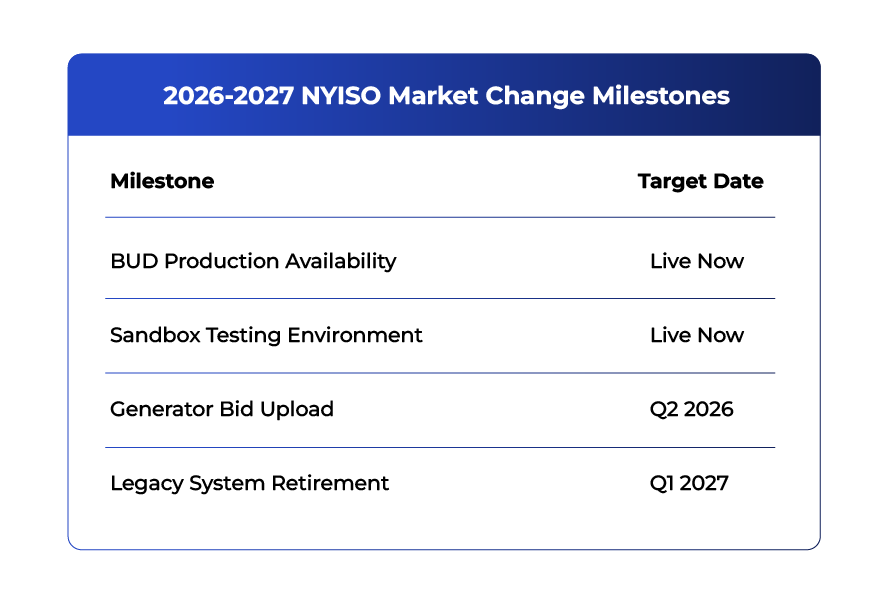
The parallel operations model provides a substantial transition window; however, participants should avoid waiting until late 2026 to begin migration efforts.
Participants Most Impacted
While all Marketplace users should review the changes, certain participant groups will experience greater operational impacts:
Load-serving entities
External transaction participants
Generator owners and operators
Scheduling coordinators
Market participants with automated API integrations
Organizations utilizing custom middleware or third-party bid platforms
The scale of impact will largely depend on how integrated the Upload/Download functionality is within internal trading or optimization systems.
How to Prepare: Recommended Action Steps
To ensure a smooth transition and mitigate operational risk, participants should take proactive steps now.
If Your Systems Are Ready:
Begin using BUD in Production for supported functionality
Confirm successful submission acknowledgments
Validate downloaded data accuracy
If You Are Still Preparing:
Continue testing in Sandbox
Review Technical Bulletin 267 in detail
Validate authentication and credential configurations
Assess API endpoint integration compatibility
Evaluate CSV-based workflows and develop migration plans
Important Reminder:
The UpDown Converter Tool is intended strictly as a temporary bridge solution. It will not be supported after the legacy system retires in Q1 2027.
Broader Market Context
Recent NYISO Markets Report discussions emphasize the increasing sophistication of market participation, including growing transaction volumes, evolving bidding strategies, and enhanced reliability oversight.
Modernizing bid submission infrastructure is essential to supporting:
Higher data throughput
Improved cybersecurity resilience
Operational transparency
Scalable integration capabilities
The BUD transition is therefore part of a broader reliability and market systems modernization effort, not a standalone software upgrade.
Hartigen’s Role & PowerOptix Updates
At Hartigen, we are closely tracking the BUD transition and actively preparing PowerOptix and related services to ensure client readiness well ahead of legacy retirement.
PowerOptix Impacts:
The modernization requires:
Connectivity code updates for processes for MIS(BUD) system
API integration enhancements
Adjustments to file formats for load and transaction bids/schedules data
Generator submission module development ahead of Q2 2026
What Hartigen Is Doing:
Our objective is to ensure that all PowerOptix users transition seamlessly, with minimal disruption to trading or operational processes by Q3 2026, based on updated information from NYISO.
Conducting technical review of Technical Bulletin 267
Updating PowerOptix integration
Enhancing security alignment with NYISO requirements
Preparing load, transaction and generator bid query/submission functionality
Supporting client Sandbox testing
Developing migration roadmaps and implementation timelines
.
Final Thoughts
NYISO’s BUD modernization marks a significant step in strengthening the technical foundation of the Marketplace. With Production access now available and generator functionality arriving in 2026, 2026 will be a pivotal year for participant migration efforts.
The key takeaway: begin testing early, validate integrations thoroughly, and avoid last-minute transitions before the Q1 2027 legacy retirement deadline.
Hartigen will continue providing updates, technical guidance, and readiness support as the rollout progresses.
References
Content in this edition reflects Hartigen’s internal expertise, with significant contributions from our Director of Product Development and NYISO expert, Rashmi Karnik.